
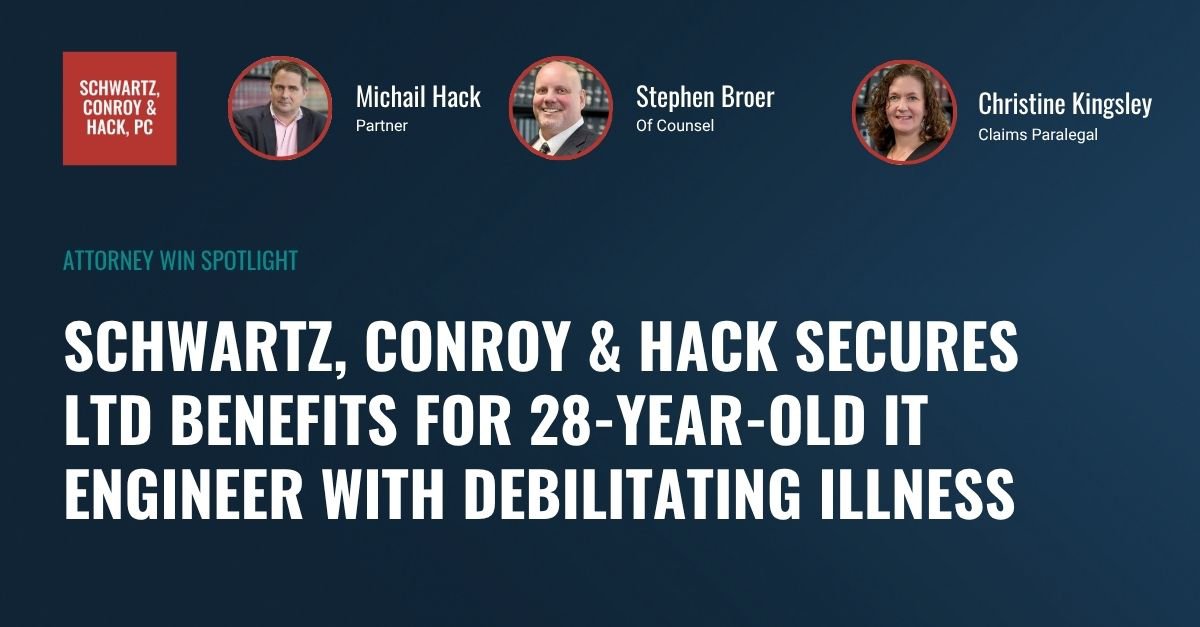
Partner Michail Hack, Of Counsel Stephen Broer and Claims Paralegal Christine Kingsley
Following a work trip to South America in 2025, an exceptional 28-year-old IT engineer developed persistent and progressively worsening symptoms that included extreme fatigue, dizziness, excessive daytime sleepiness and severe brain fog. The symptoms never dissipated and, in fact, became so debilitating that the IT engineer could no longer perform the duties of their profession.
The Challenge
The IT engineer, who had both short-term and long-term disability insurance policies, filed a short-term disability claim with the insurer. However, the insurer denied the claim, concluding that the insured could still perform their job, even though the position required intense attention to detail, constant meetings throughout the day, and the ability to manage ever-shifting priorities. The insured attempted to appeal the denial on their own, but that appeal was also denied.
The Solution
That’s when the insured contacted Schwartz, Conroy, & Hack, PC. From the outset, our team of Partner Michail Hack, Of Counsel Stephen Broer and Claims Paralegal Christine Kingsley had two goals: securing the short-term disability benefits for the client and, more importantly, obtaining long-term disability benefits.
Our team submitted the same evidence in support of both the short-term disability appeal and the long-term disability benefits claim. This evidence included detailed expert narratives from a neuropsychologist and neurologist, as well as personal statements from the client, family members and friends describing what the client was like before the illness, how the client’s condition developed and the profound impact it has had on the client’s daily life. Once a highly functioning professional, the client now sleeps 15 to 16 hours per day, experiences significant weakness, and is a shell of the person they once were.
The Result
Due to the strong evidence we gathered and provided, the long-term disability claim was approved within two weeks. Nevertheless, the short-term disability claim is still under review.
Insurers are not supposed to factor a claimant’s age into their decisions. However, they often recognize when a claim could lead to substantial payments over a long period of time. A 28-year-old claimant is a prime candidate for such scrutiny, and the insurer knew that approving the claim would significantly impact its bottom line.
By presenting a strong legal argument supported by documented witness statements and detailed expert narratives, we forced the insurer to approve the long-term disability claim and pay the benefits that it owed to our client.
If your insurance claim has been denied or is being challenged, contact Schwartz Conroy & Hack, PC. We have the expertise, experience and tenacity to make insurance companies keep their promises to policyholders like you.